How to keep lumpy bumpy breasts safe? How to turn the tide.
Why are we not teaching docs & patients how to stay safer, not just continual biopsying and imaging?

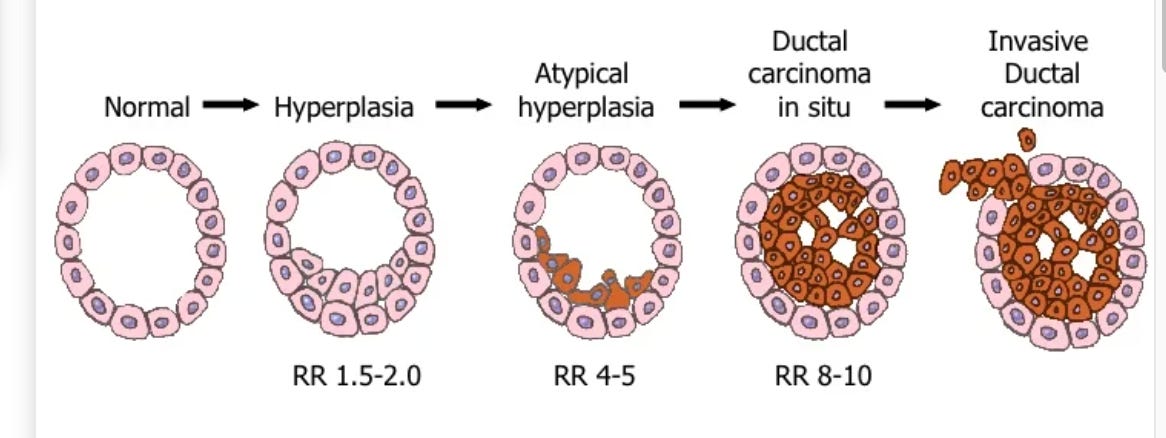
When women find bumps in their breast tissue, they get imaged, get biopsies, and continue to get monitored.
Watched.
Even if the stages are diagnosed as “precancerous”, these same women are sent home with no recommendations of how to turn this tide of their cells getting nastier characteristics.
Women get more imaging.
More monitoring.
Yet… they are not given helpful lifestyle recommendations, like food, nutrients and even repurposed medications, to reverse these nasty early cellular changes.
Medicine is “wait and see”.
We see you have nasty cellular changes.
That are putting your breasts and health at risk.
But go home.
In the future, expect more mammograms. More biopsies.
But no recommendations of how to help this breast tissue healthier like it was when you were younger.
Let’s say your breast tissue is lumpy. Tender.
You have been diagnosed with fibrocystic disease.
Your breast tissue is becoming unhealthy.
It should NOT have lots and lots of bumps.
Over time you get lots of biopsies.
A biopsy removes small tissue or cell samples for laboratory examination, typically to diagnose cancer, infections, or inflammatory conditions.
When biopsies reveal nasty cellular changes, cells are becoming atypical, not normal, these tissues are then more at risk of cancers.
These breast tissues are changing in ways making your breast more vulnerable to cancer.
These changing tissue biopsy results can be called atypical hyperplasia. Your cells don’t look normal.
Or even worse.
Or atypical lobular hyperplasia. An even higher risk cellular change.
These tissue changes increase a woman’s risk of getting breast cancer enormously.
I had many biopsies of “atypical lobular hyperplasia” before I had breast cancer.
Even when I had breast cancer, the cells around the tumor also were atypical hyperplasia.
They even found in a resection after my lumpectomy (took more tissue than the first lumpectomy, as didn’t have great margins) more atypical lobular hyperplasia.
I was told, over and over again, you have unhealthy cellular changes in your breast tissue.
What to do?
We’ll keep “watching” you.
But no one gave me advice of what I might do to change this fate.
Women in the US have one in eight chances of getting breast cancer over their life times.
This risk is amplified 4 times if you have tissues changes like atypical lobular hyperplasia.
Then you really are “going home” and crossing your fingers hoping to not get where your breast cells seems determined to go.
What’s going on?
Providers are NOT trained to offer protective protocols to turn these trajectories toward safer futures.
It’s as though we know your breast tissue is having problems, many of your cells are making nasty changes, but go home and keep living like you are living, keep eating what you are eating, cross your fingers, and keep getting mammograms to keep ruling out future pathologies.
We will keep imaging you.
Monitoring you.
Waiting for you to “get worse”.
But no steps to get you better in the mean time.
This system makes no sense.
Once cells are starting to “turn” we should encourage the woman to “act”.
To take protective steps.
Which are?
A cleaner diet, give up the cigarettes, drink less alcohol, ditch the sugar, ditch the ultra-processed foods.
Go off birth control pills or IUDs with synthetic progestins, these are kryptonite to breasts with altering celluar changes. Women with atypical lobular hyperplasia have increased breast cancer risks, so should avoid exogenous synthetic hormones, particularly combined oral contraceptives.
Iodine.
Progesterone.
Vitamin D. Vitamin D levels are highly linked to cancer outcomes. Lower vitamin D levels mean more risk, while healthier higher levels mean less risk (55 to 75 in healthy women and 85 to 95 in women with breast cancers).
Specific botanicals signal safer breast cells.
Iodine care-takes healthy architecture of “all” glandular tissue.
From breasts, to thyroid, uterus, ovaries, prostate and even the pancreas.
Healthy iodine tissue levels are under attack.
From what? Bromine in ultra-processed foods, from chlorine and fluoride in water, toothpaste, etc.
Iodine treatment, replacement, literally, over just a few months, starts to heal breast tissue, ridding breast tissue of lumps and bumps.
Making these tissues safer. Less at risk of worsening damage.
What else protects breast cells?
Natural progesterone.
Not synthetic progestins.
Progesterone signals protect breast tissue.
Testosterone signals protect breast tissue.
Soy isoflavones and other specific botanicals, protect breast tissue.
If more and more earlier nasty tissue changes in breast tissues were sensibly treated with natural answers, we would have less women proceeding onwards to breast cancer.
But once we have breast cancer, we also have lots of answers, more than just crossing your fingers and hoping it doesn’t come back.
We have nutrients, hormones, repurposed medications that give cancer survivors much greater chances of staying well longer.
Specific foods.
Specific meds.
Backed by science.
But not recommended to us by our oncologists.
That’s what we do in our Everything Breast Cancer online CME course.
We have 15 experts sharing answers to help breast cancer patients stay safer.
Nutrients and hormones you can take during chemo and radiation.
Some you can’t.
And why.
We share how and when to consider hormone replacement.
Who are candidates. Who aren’t.
How to read markers to guide recommendations.
How to sane conversations with patients and oncologists.
This is a great body of detailed science-based tools and guidelines.
More and more cancer patients are happening at younger and younger ages.
How do we keep their lives vibrant?
And safer?
This historic ONLINE 20 hr. CME course, Everything Breast Cancer, is $1675.
Once it toes Evergreen, right after the course is over, the cost will increase to $1825.
Here is the course outline:
Presentation Schedule
Day One
Session One – Why The Fear of Estrogen?
New estrogen receptors ( ERalpha66 vs. ERalpha36), what drives “good” to “bad” actions. These set the scene for many of this conference’s presentations.
Hormones as protectors, what drives rogue behavior, what to test, track, and treat in patients
Review of 25 human trials prescribing estrogen replacement to ER+ patients
Breast cancer subtypes: adenocarcinoma, lobular, pure
mucinous, DCIS, triple negativeHow to read markers Ki-67, VEGF, etc
Estrogen Gap Hypothesis and how these guide conversations
Session Two – A Cancer as a Mitochondrial Metabolic Disease
Recognize cancer as primarily a mitochondrial metabolic disease, not a genetic disease
Understand cancer as defective respiration with compensatory fermentation regardless of cellular or genetic heterogeneity
Ketogenic metabolic therapy (KMT) as a cost-effective, non-toxic strategy that targets breast cancer cells while protecting normal-cell energy efficiency
Session Three – Metabolic Cause and Treatment of Breast Cancer
Major metabolic drivers of cancer & effective nutrients
Adjunctive medications
Nutrients to select/avoid during radiation and chemo
Natural strategies for minimizing radiation & chemo effects
How to protect healthy cells during chemotherapy
Inspirational Interview Series: (non-CME) – Dr. Jill Carnahan
Dr. Jill Carnahan shares her experience overcoming aggressive breast cancer and Crohn’s disease, with practical lessons on resilience, hormone therapies and gut protection during treatment.
Session Four – Conversations to Testing to Treatment Guidelines
Initiate conversations with breast cancer patients exploring risks vs. benefits of HRT
Determine appropriate BHRT treatment protocols from 24-hour urine analysis
Explain estrogen-optimizing pathways using botanicals, nutrients, and hormones
Session Five – Estrogen’s Real Science Part 1
Human vs equine estrogen in proliferation rates & estrogen receptor targeting
Criteria for HRT in breast cancer survivors
Ki-67 markers and pathology parameters
Three phases of Tamoxifen resistance
Session Six – Iodine Controversies
Common controversies around high‑dose iodine
Safe clinical use of Iodine
Testing for iodine deficiency
Individualized replacement strategies.
Functional approaches for thyroid and breast disorders
Collaborative care with oncologists
Session Seven – 3 Experts – Case Reports: Using HRT in Breast Cancer Patients
Histories, HRT protocols, and patient progress from three expert case reports
Clinical implications of HRT in breast cancer patients
Case-based insights to personalize HRT decisions for breast cancer survivors
Non-CME Q&A
Day Two
Session Eight – Testosterone and Breast Cancer
Testosterone’s physiological role and intracrine conversion to estradiol
The rationale and mechanism for T+AI in implants for breast cancer survivors
Clinical benefits of T+AI therapy through the analysis of case reports
Session Nine – Estrogen’s Real Science Part 2
Human vs equine estrogen in proliferation rates & estrogen receptor targeting
Criteria for HRT in breast cancer survivors
Ki-67 markers and pathology parameters
Three phases of Tamoxifen resistance
Session Ten – The Role of Repurposed Drugs in Treating Cancer
The role of repurposed drugs for breast cancer and their tiered application
Strategies to manage chemotherapy‑related adverse effects
Nutrient safety during chemo/radiation and when to reintroduce supplementation
Session Eleven – A Clinician’s Guide to the Journey
RGCC and how its testing, tracking, and vaccines help advanced cancer patients thrive
Use of ozone and whole blood irradiation and dosing in cancer patients
Case-based insights regarding nutrients, botanicals, and repurposed medications for breast cancer patients
Inspirational Interview Series: (non-CME) – Dr. Jeff Kotulski
Dr. Jeff Kotulski, immunotherapy expert, discusses when and how immunotherapy can make the greatest impact.
Session Twelve – What Drives Recurrence: The Science, The Cases
TGF‑β1 and dormant tumor cell roles in recurrence
Botanicals and nutrients that inhibit dormant tumor cells
Hydroxychloroquine + rapamycin phase 2 trial and mTOR pathway
Session Thirteen – The Progesterone Paradox
Physiologic and pathophysiologic roles of progesterone in breast tissue and their relevance to cancer risk and progression
Natural progesterone vs. synthetic progestogens: differential effects on breast cancer biology, receptors, and hormone therapy
Evidence‑based use of progesterone in high‑risk patients and breast cancer survivors
Session Fourteen – Strategies for T-Cell Upregulation: Evidence-Based Approaches to Boost T-Cell Response in Cancer Patients
Bioactive food components that enhance T cell function
Why anthocyanin-rich foods are essential for cancer patients
The pros and cons of soy and strategies for patients with allergies
Session Fifteen – Case Studies: Breast Cancer Patients and Hormones
Clinical histories and hormone protocols from multiple expert case reports
Implications of hormone therapy in breast cancer
Case insights for individualized hormone management
Non-CME Q&A
Day 3
Session Sixteen – Breast Cancer Pearls: From Dosing Melatonin to Treating Lymphedema
Melatonin dosing
Jordan’s estrogen‑deprivation theory
Stair‑step hormone strategies and dietary recommendations
Functional strategies for lymphedema, radiation burns, and kidney protection during chemotherapy
Tracking spike protein IgG and how to “detoxify” this carcinogen
Session Seventeen – Hormone Testing and Efficacy
Appropriate hormone testing for breast cancer patients
Interpreting results for breast cancer patients
Hormone bases and delivery modes comparisons (including special considerations)
FSH monitoring to assess estrogen efficacy and tissue protection
Inspirational Interview Series: (non-CME) – Dr. Anna Cabeca
Dr. Anna Cabeca addresses vaginal health, intimacy, and hormone considerations during and after breast cancer treatment.
Session Eighteen – Iodine and Breast Cancer Recurrence
Iodine’s role in modulating estrogen metabolism for breast cancer prevention
How DIM works with iodine to support estrogen pathways
Iodine + DIM protocols for recurrence‑risk reduction.
Session Nineteen – What Nutrients Must Be Avoided During Allopathic Cancer Care and When to Restart?
Nutrients to avoid during radiation/chemotherapy
Appropriate timing to restart supplementation.
Recommend protective nutrients for patients undergoing treatment
Session Twenty – Hormones and High‑Risk Cardiac Patients
Studies and delivery modes that support safe HRT use in high‑risk cardiac and genetic pro‑coagulatory patients.
Estrogen’s cardioprotective mechanisms
Strategies for cardiac protection during chemo
Session Twenty-One – Iodine: The Universal Anticancer Agent
Therapeutic use of iodine in breast and other cancers
Individualized dosing
Testing and treatment duration
Case reports
Knowledge is power.
Many of the providers in this course either had cancer themselves, their loved ones, or they have many patients that they have helped from early cancer even to stage 4.
Come join us for this exciting power-packed symposium.
ONLINE for your convenience.
Remaining online for you to go over the material as much as you want.
At your convenience.
We have many lectures, chats, inspiring interviews, making this much more than just didactic delivery.
This is a unique educational event you do not want to miss.
Dr. B.
